


Visiting the sacred city of Puri is a deeply spiritual experience for devotees of Lord Jagannath.
The sound of temple bells, the fragrance of incense, the sight of the magnificent temple tower, and the devotion of thousands of pilgrims create an atmosphere that is difficult to describe in ordinary words.
For many devotees, having darshan of Mahaprabhu Jagannath is a lifelong dream.
The famous Shree Jagannath Temple is located in Puri, Odisha, and is one of the most important Hindu pilgrimage destinations in India.
Dedicated to Lord Jagannath, Lord Balabhadra, and Goddess Subhadra, this ancient temple welcomes devotees throughout the year.
However, visiting at the right time is important because temple darshan follows a traditional sequence of daily rituals.
If you are planning a pilgrimage, understanding the Puri Temple Timings 2026 will help you organize your visit comfortably.
This guide covers the temple’s opening and closing times, daily darshan schedule, Mangala Aarti, puja timings, Mahaprasad, entry rules, festivals, and other useful information for devotees.
About Shree Jagannath Temple, Puri

Shree Jagannath Temple is one of the most sacred Hindu temples in India. Situated in Puri, Odisha, it is also an important destination of the Char Dham pilgrimage.
The temple is dedicated to Lord Jagannath, a form of Lord Vishnu and Krishna, who is worshipped along with his elder brother Lord Balabhadra and sister Goddess Subhadra.
The temple has a remarkable history dating back to the 12th century.
Its construction is traditionally associated with King Anantavarman Chodaganga Deva, who contributed significantly to the development of the magnificent temple complex.
One of the most distinctive features of the temple is its wooden deities.
Unlike many Hindu temples that house stone or metal idols, the principal deities of Jagannath Temple are made from sacred neem wood, known as Daru.
These idols are renewed through a special religious tradition called Navakalevara, which takes place according to specific astrological and traditional conditions.
The temple is not only a place of worship but also the centre of Odisha’s religious and cultural traditions.
Its famous Rath Yatra attracts millions of devotees who gather to witness the grand chariot procession.
Puri Temple Timings 2026
The temple generally opens early in the morning and remains active until late at night.
However, darshan is not continuously available because several important rituals are performed throughout the day.
According to the published temple schedule, the sanctum doors open around 4:30 AM, while general darshan usually begins around 5:30 AM after the morning rituals.
Here are the general visiting details for 2026:
| Temple Information | Timings / Details |
|---|---|
| Temple location | Puri, Odisha, India |
| Temple opening ritual | Around 4:30 AM |
| General darshan begins | Around 5:30 AM |
| Morning Mangala Aarti | Around 5:30 AM |
| Afternoon darshan | Generally after midday rituals |
| Evening Aarti | Around 6:00 PM |
| Last night rituals | Around 11:00–11:30 PM |
| Weekly opening | Generally open daily |
| Entry fee | No general entry fee |
| Main deities | Jagannath, Balabhadra and Subhadra |
Important: These timings are indicative, not guaranteed entry hours. The temple administration performs rituals in sequence, and delays can affect the darshan schedule.
Festival days and special religious occasions may also bring significant changes.
Jagannath Temple Opening and Closing Timings
The opening of Jagannath Temple begins with Dwaraphita, the sacred ritual during which the doors of the sanctum are opened. This usually takes place around 4:30 AM.
After the morning rituals, devotees generally begin receiving darshan at approximately 5:30 AM.
The temple remains active throughout the day, with short interruptions for food offerings, dressing ceremonies, and other traditional activities.
The final ritual of the day is associated with Khata Seja Lagi and Pahuda, when the deities are prepared for rest and the temple doors are closed for the night.
The main details are:
- Opening ritual: Around 4:30 AM.
- Morning darshan: Around 5:30 AM.
- Afternoon activities: Continue according to the daily puja schedule.
- Evening darshan: Available after the evening rituals.
- Night closing ritual: Around 11:30 PM.
Devotees should not assume that the temple’s opening and closing hours mean darshan is available throughout this entire period. Certain ceremonies temporarily restrict public viewing.
Jagannath Temple Daily Darshan and Puja Schedule
The daily routine at Shree Jagannath Temple is known as Niti. These rituals are performed by traditional temple servitors according to established customs.
Each ceremony has its own religious importance, from awakening the deities in the early morning to preparing them for rest at night.
The following schedule provides a general understanding of the daily activities.
| Time | Ritual / Seva | Description |
|---|---|---|
| 4:30 AM | Dwaraphita | Opening of the sanctum doors |
| 5:30 AM | Mangala Aarti | Morning worship with lamps |
| 6:00 AM | Mailam | Changing the previous day’s clothes and decorations |
| 6:00–6:30 AM | Abakash | Morning cleansing rituals |
| 7:00–8:00 AM | Sahanamela | Special public darshan, subject to arrangements |
| Around 8:00 AM | Beshalagi | Dressing and decoration of the deities |
| 8:30–9:00 AM | Gopala Ballava Puja | Morning food offering |
| 9:00–10:00 AM | Sakala Dhupa | Morning meal offering |
| Around 11:30 AM | Bhoga Mandap | Additional food offering |
| 12:00–1:00 PM | Madhyanha Dhupa | Midday food offering |
| Around 1:00 PM | Madhyanha Pahuda | Afternoon resting ritual |
| Around 5:30–6:00 PM | Sandhya Aarti | Evening worship |
| 6:30–8:00 PM | Sandhya Dhupa | Evening food offering |
| Around 8:30 PM | Chandana Lagi | Sandalwood application ritual |
| 9:30–10:30 PM | Badashringara Vesha | Night decoration of the deities |
| Around 11:30 PM | Khata Seja Lagi and Pahuda | Final resting ceremony |
The schedule is useful for planning, but not every ceremony starts at exactly the listed time.
Some rituals may take longer than expected, which can affect subsequent activities.
Jagannath Temple Aarti Timings
Aarti is one of the most beautiful parts of worship at Jagannath Temple.
Devotees gather to experience the spiritual atmosphere as lamps are offered to the deities along with prayers, bells, and devotional chanting.
Two particularly important daily aarti ceremonies are Mangala Aarti and Sandhya Aarti.
Mangala Aarti Timings
Mangala Aarti is the early morning worship ceremony performed after the temple doors are opened. It generally takes place around 5:30 AM.
During this ritual, the deities are welcomed with sacred lamps and devotional prayers.
For devotees who prefer a peaceful morning atmosphere, arriving early can make the pilgrimage especially meaningful.
The ceremony also marks the beginning of the temple’s daily activities. General darshan usually follows the completion of the necessary morning rituals.
Sandhya Aarti Timings
Sandhya Aarti is the evening worship ceremony, generally performed around 5:30–6:00 PM.
As daylight begins to fade, the temple atmosphere becomes filled with the sound of bells, conch shells, and devotional prayers.
It is a special time for devotees who wish to experience the evening traditions of Lord Jagannath.
The exact timing can change according to the temple’s daily ritual arrangements, so visitors should check the current schedule before arriving.
Important Puja and Rituals at Jagannath Temple

The daily worship system of Jagannath Temple includes several traditional ceremonies. Each ritual represents a different part of the daily service offered to the deities.
Dwaraphita and Mangala Aarti
Dwaraphita marks the opening of the temple doors early in the morning. It is followed by Mangala Aarti, during which lamps are offered to Lord Jagannath and the other deities.
Mailam and Abakash
Mailam involves changing the previous day’s clothes and decorations. Abakash is associated with the morning cleansing rituals of the deities.
These ceremonies are important parts of the traditional worship routine and take place before the main morning food offerings.
Gopala Ballava Puja
Gopala Ballava Puja is the morning food offering, generally performed around 8:30 AM.
Fruits, sweets, milk based preparations, and other traditional items may be offered to the deities.
It represents the morning meal in the daily routine of Lord Jagannath.
Sakala Dhupa
Sakala Dhupa is the main morning food offering, generally scheduled between 9:00 AM and 10:00 AM.
Various traditional food preparations are offered with religious devotion. Public darshan arrangements may change during this ceremony.
Madhyanha Dhupa
Madhyanha Dhupa is the midday food offering, usually performed around noon or during the early afternoon.
It is one of the important daily ceremonies and forms part of the traditional food offering system of the temple.
Badashringara Vesha
Badashringara Vesha is the final decorative appearance of the deities before their nighttime rest.
The deities are adorned with traditional clothing, flowers, and other decorations. This beautiful ceremony is an important part of the evening worship tradition.
Khata Seja Lagi and Pahuda
Khata Seja Lagi and Pahuda are associated with preparing the deities for rest. The ceremony takes place late at night, generally around 11:30 PM.
After the completion of the final rituals, the temple doors are closed.
Jagannath Temple Darshan Ticket Price and Entry Fee
One of the most common questions among devotees is whether they need to purchase a ticket for darshan.
General darshan at Shree Jagannath Temple is free. Devotees do not need to purchase a regular entry ticket to enter the temple, provided they meet the applicable entry requirements.
Some important details include:
- General darshan is available without an entry fee.
- Devotees should follow the instructions of temple authorities.
- Special ritual participation may involve separate arrangements.
- VIP or special darshan charges should not be assumed without official confirmation.
- Avoid paying unauthorized individuals who promise quicker entry.
The availability of special arrangements can change according to administrative decisions.
Always check the official temple administration’s latest announcements before making any payment.
Sahanamela Darshan at Jagannath Temple

Sahanamela is an important term for devotees visiting Jagannath Temple.
It refers to a special public darshan arrangement during which devotees may be allowed closer access to the deities, subject to the temple’s arrangements.
It is particularly meaningful for pilgrims who wish to experience darshan from a closer position.
However, Sahanamela does not necessarily take place at the same time every day.
Its availability depends on the daily rituals, temple administration, and other religious arrangements.
Visitors should ask the temple authorities about the current Sahanamela schedule rather than depending entirely on previously published timings.
Mahaprasad at Jagannath Temple
No visit to Puri is complete without learning about Mahaprasad, the sacred food associated with Lord Jagannath.
Mahaprasad is prepared in the temple kitchen according to traditional methods and offered to the deities before being distributed among devotees.
The kitchen is famous for its traditional cooking system, in which food is prepared in earthen pots.
After the offering, devotees can purchase or receive Mahaprasad at Anand Bazaar, located within the temple complex.
Some important things to know about Mahaprasad include:
- It is prepared using traditional ingredients and cooking practices.
- Rice, dal, vegetables, and different sweets are among the preparations.
- The food is first offered to Lord Jagannath.
- Anand Bazaar is the main place associated with its distribution and sale.
- The availability and variety of preparations may change during the day.
For many devotees, eating Mahaprasad is an important part of the pilgrimage. It is not simply a meal but a religious tradition that represents devotion, equality, and community.
There is no single guaranteed daily Mahaprasad collection time for every preparation. Visitors should ask at Anand Bazaar about current availability.
Major Festivals Celebrated at Jagannath Temple

Jagannath Temple is famous for its colourful festivals and ancient religious celebrations.
During these occasions, the temple becomes an important centre of devotion, attracting pilgrims from different parts of India and abroad.
Rath Yatra
Rath Yatra is the most famous festival associated with Lord Jagannath.
During this grand annual celebration, the deities of Lord Jagannath, Lord Balabhadra, and Goddess Subhadra are taken out of the temple in beautifully decorated wooden chariots.
Thousands of devotees gather to pull the massive chariots through the streets of Puri.
The festival represents the opportunity for people to receive the blessings of the deities outside the temple.
Temple rituals and public access arrangements change considerably during Rath Yatra. Visitors should check the festival schedule before travelling.
Snana Yatra
Snana Yatra is an important annual bathing festival celebrated on the full moon day of the Hindu month of Jyeshtha.
During the ceremony, the deities are brought to the Snana Mandapa and given a ceremonial bath with sacred water.
Following Snana Yatra, the deities traditionally enter a period known as Anasara, during which regular public darshan is not available for approximately 15 days.
Chandan Yatra
Chandan Yatra is another important festival celebrated at Jagannath Temple. It is associated with sandalwood paste and water-related religious ceremonies.
The festival traditionally continues for 42 days and includes several activities involving the deities and their ceremonial representatives.
Navakalevara
Navakalevara is a unique religious tradition in which the wooden idols of the deities are renewed using sacred neem wood.
This ceremony takes place when specific astrological conditions occur, rather than on an ordinary fixed annual date.
It is considered one of the most significant events in Jagannath culture.
Other Festivals
Other important celebrations include Makara Sankranti, Dola Purnima, Pana Sankranti, and Kartika Purnima.
During these occasions, special pujas and traditional ceremonies may affect normal Jagannath Temple darshan timings.
Jagannath Temple Dress Code and Entry Rules
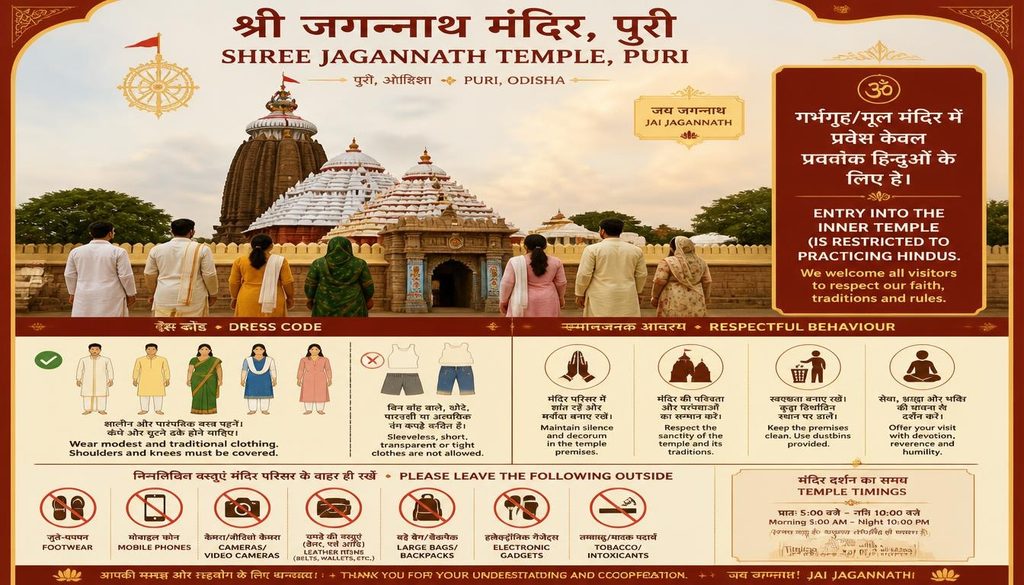
Devotees visiting Shree Jagannath Temple should respect its traditional customs and follow the instructions of the temple administration.
Although there is no general entry ticket, certain religious and security rules apply to visitors.
Here are some useful guidelines:
- Wear clean and respectful clothing.
- Traditional Indian clothing is a suitable choice for temple visits.
- Avoid clothing that is considered inappropriate under the temple’s current dress guidelines.
- Follow the instructions of security personnel.
- Do not create disturbances inside the temple premises.
- Maintain cleanliness throughout the visit.
- Follow restrictions concerning photography and electronic devices.
- Do not carry prohibited objects inside the temple.
Can Non-Hindus Enter Jagannath Temple?
Entry into the inner temple premises is traditionally restricted to Hindus. Non Hindu visitors are not generally permitted to enter the temple for darshan.
However, they can experience the temple’s magnificent architecture from outside.
The nearby Raghunandan Library area is also traditionally known as a viewing location for observing the temple from an elevated position.
Visitors should respect the temple’s established religious customs.
Best Time to Visit Jagannath Temple Puri
Choosing the right time can make a considerable difference to your pilgrimage.
Puri experiences different weather conditions throughout the year, and the number of visitors also changes during festivals and holidays.
The period from October to March is generally considered comfortable for visiting Puri because the weather is comparatively pleasant.
Winter Season: October to February
Winter is one of the most suitable periods for visiting Jagannath Temple.
The weather is generally comfortable, making it easier for families, older devotees, and other pilgrims to explore the temple and surrounding areas.
However, weekends and holiday periods can still be crowded.
Summer Season: March to June
Summer temperatures can become quite high in Odisha. Devotees visiting during these months should prefer early morning darshan and carry drinking water for use outside the temple.
It is also important to check the festival calendar, particularly around Snana Yatra and the Anasara period.
Monsoon Season: July to September
The monsoon brings rainfall to Puri, and outdoor travel may become less comfortable.
Nevertheless, this period can be important for devotees interested in the Rath Yatra celebrations, depending on the Hindu calendar.
Book accommodation in advance if you plan to visit during major festivals.
Accommodation Near Jagannath Temple
Puri offers different accommodation options for pilgrims visiting Shree Jagannath Temple.
Visitors can choose from budget hotels, guesthouses, dharamshalas, and other lodging facilities.
Some devotees prefer staying close to the temple so that they can attend early morning darshan without worrying about long travel distances.
The Jagannath Temple Administration also provides accommodation-related services through its Bhakta Niwas facilities.
Before booking, consider the following points:
- Choose accommodation according to your budget.
- Check the distance from the temple.
- Confirm room availability during festivals.
- Review cancellation policies before making payment.
- Book early during Rath Yatra and other major celebrations.
- Use official accommodation booking channels wherever possible.
Planning accommodation in advance makes the pilgrimage more comfortable, especially when travelling with children or elderly family members.
Important Tips for Devotees Visiting Jagannath Temple
A little preparation can make your visit much smoother. Since the temple follows a traditional ritual schedule, it is helpful to understand the basic arrangements before reaching Puri.
Here are some practical suggestions:
- Arrive early if you want to experience morning darshan.
- Check the latest Puri Temple Timings before travelling.
- Allow extra time for security checks and queues.
- Avoid visiting only according to an online timetable.
- Ask temple authorities about current darshan arrangements.
- Keep your belongings in accordance with the temple’s security rules.
- Respect the customs followed by temple servitors.
- Visit Anand Bazaar to learn about Mahaprasad availability.
- Avoid unauthorized agents offering VIP darshan.
- Check festival related restrictions before planning your trip.
Most importantly, remain patient. Large crowds and ritual delays are common during busy periods, and a little flexibility can make your visit much more peaceful.
How to Reach Jagannath Temple, Puri
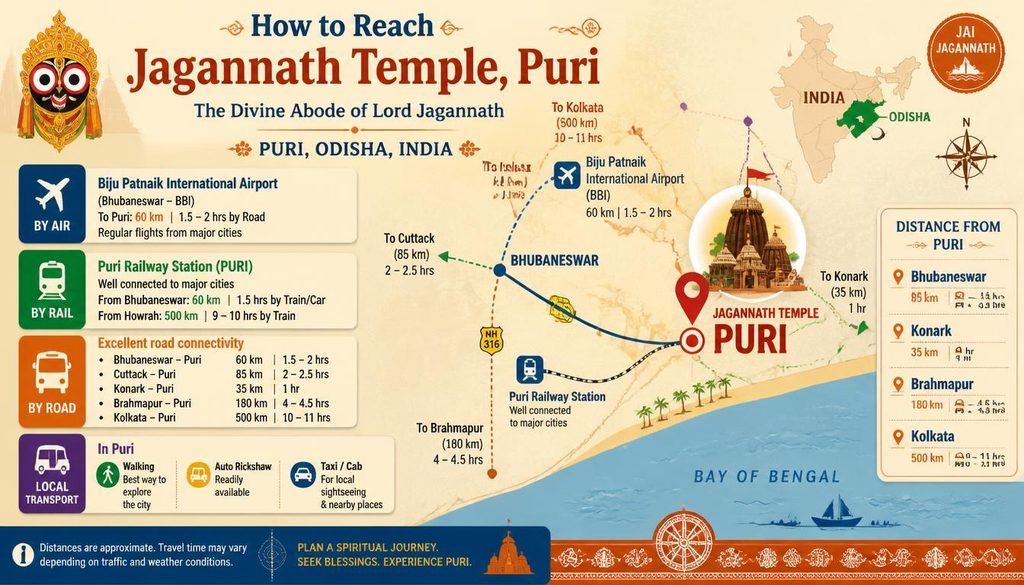
Puri is well connected with several major cities of Odisha and other parts of India. Devotees can reach the city by train, road, or air.
By Train: Puri Railway Station is an important railway station with connections to several major Indian cities.
From the station, visitors can hire an auto rickshaw, taxi, or other local transport to reach Jagannath Temple.
By Air: Biju Patnaik International Airport in Bhubaneswar is the nearest major airport.
It is approximately 60 kilometres from Puri by road, although actual travel distance and time depend on the route and traffic.
By Road: Puri is connected to Bhubaneswar and other destinations through road networks. Regular buses, taxis, and private vehicles are available for travelling to the city.
Once you reach Puri, local transportation makes it relatively convenient to travel to the temple area.
Frequently Asked Questions About Puri Temple Timings
What are the Puri Temple Timings in 2026?
Shree Jagannath Temple generally opens its sanctum doors around 4:30 AM, and public darshan usually begins around 5:30 AM.
The final nighttime rituals take place around 11:30 PM. Actual timings can change according to daily rituals and special occasions.
What time does Jagannath Temple open in the morning?
The opening ritual, known as Dwaraphita, generally takes place around 4:30 AM. Devotees usually begin receiving darshan around 5:30 AM after the morning worship arrangements.
What is the Mangala Aarti time at Jagannath Temple?
Mangala Aarti is generally performed around 5:30 AM. It is an important morning ceremony during which sacred lamps are offered to Lord Jagannath, Lord Balabhadra, and Goddess Subhadra.
Is Jagannath Temple darshan free?
Yes, general darshan at Shree Jagannath Temple is free. There is no regular entry fee for devotees.
Any special seva or other arrangements should be confirmed through the temple administration.
What is the evening Aarti time at Puri Jagannath Temple?
Sandhya Aarti is generally performed around 5:30–6:00 PM. However, the actual timing can vary depending on the daily ritual schedule.
Can devotees visit Jagannath Temple throughout the day?
Darshan is available during several periods throughout the day, but it is temporarily interrupted for important rituals and food offerings.
Visitors should check the current darshan schedule before arriving.
What is the dress code for Jagannath Temple?
Devotees should wear clean and respectful clothing and follow the temple’s current dress and entry guidelines. Traditional Indian clothing is a suitable choice.
Where can devotees get Mahaprasad in Puri?
Devotees can obtain Mahaprasad at Anand Bazaar inside the temple complex. The food is prepared in the traditional temple kitchen and offered to Lord Jagannath before distribution.
Are mobile phones allowed inside Jagannath Temple?
Electronic devices and mobile phones are subject to temple security restrictions.
Visitors should check the latest instructions and use designated storage facilities where available.
When is Rath Yatra celebrated in Puri?
Rath Yatra is celebrated annually according to the Hindu lunar calendar, generally during the month of Ashadha.
The festival involves the ceremonial procession of Lord Jagannath, Lord Balabhadra, and Goddess Subhadra in their grand chariots.
Are temple timings different during festivals?
Yes. Major festivals such as Rath Yatra, Snana Yatra, and Navakalevara can significantly change the normal ritual and darshan arrangements.
Visitors should confirm the festival specific schedule before travelling.
read more;https://gavorexium.com/sugam-darshan-ayodhya-2026-online-booking-e-pass-and-guide/
Conclusion
A visit to Shree Jagannath Temple is much more than an ordinary religious journey. It is an opportunity to experience centuries of faith, devotion, traditional worship, and the unique cultural heritage of Odisha.
From the peaceful atmosphere of Mangala Aarti to the beautiful evening rituals and the sacred taste of Mahaprasad, every part of the pilgrimage holds a special place in the hearts of devotees.
Knowing the Puri Temple Timings 2026, daily puja schedule, darshan arrangements, and important entry guidelines can help you plan your visit with greater confidence.
Remember that temple timings are subject to changes, so always check the latest announcements before travelling.
Whether you are visiting for the first time or returning to seek the blessings of Mahaprabhu, may your journey to Puri be filled with devotion, happiness, and spiritual peace.