

There are stories that entertain us for a moment, and then there are stories that quietly change the way we look at life.
The story of Lord Rama belongs to the second kind.
His journey is filled with love, sacrifice, courage, difficult choices, and a deep commitment to doing what is right, even when the path ahead seems almost impossible.
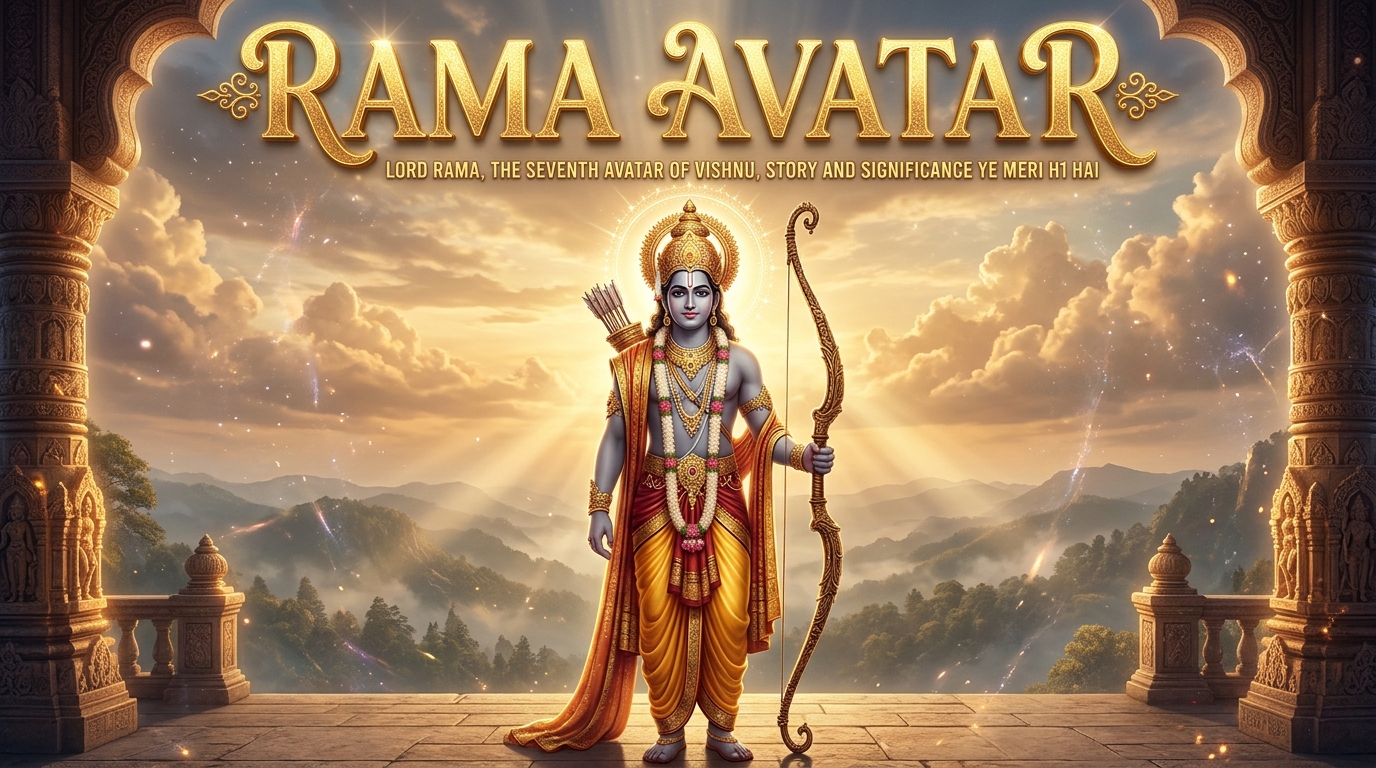
The Rama Avatar holds a special place in Hinduism as the incarnation of Lord Vishnu who appeared on Earth to uphold dharma and restore balance between good and evil.
Revered as Shri Ram, Ramachandra, and Lord Rama, he represents truth, compassion, discipline, and the responsibilities that come with power.
His life is remembered through sacred literature, family traditions, temple worship, and festivals celebrated by millions of devotees.
What makes Lord Rama so meaningful is not simply his victory over Ravana.
It is also the way he responds to hardship, respects his responsibilities, and continues forward when life does not unfold as expected.
His story reminds people that righteousness is not always the easiest choice, but it remains a choice worth making.
What Is Rama Avatar in Hinduism?
In Hindu tradition, an avatar is a divine incarnation through which God appears in the world to protect righteousness and restore cosmic order.
Lord Vishnu, regarded as the preserver in the Hindu Trimurti, is associated with several important incarnations known collectively as the Dashavatara, or ten principal avatars.
The Rama Avatar of Vishnu is traditionally recognized as the seventh avatar in this sequence
. According to the Ramayana, Lord Rama’s life illustrates the struggle between dharma (righteous duty) and adharma (unrighteous conduct).
His incarnation is closely connected with the defeat of Ravana, the powerful king of Lanka whose actions disrupt the moral and spiritual order.
Yet the significance of Rama’s appearance goes beyond defeating a powerful opponent.
His story explores the importance of keeping promises, protecting others, showing courage, and accepting responsibility.
For many devotees, Rama is not only a divine figure but also a guide for everyday life.
His example encourages people to speak truthfully, treat others fairly, and remain steady during challenging times.
Why Is Lord Rama Called the Seventh Avatar of Vishnu?
The traditional list of ten principal incarnations of Vishnu includes Matsya, Kurma, Varaha, Narasimha, Vamana, Parashurama, Rama, Krishna, Buddha in some traditions, and Kalki, whose appearance is associated with the future.
Lists and interpretations can vary across Hindu traditions.
Lord Rama is placed seventh in the commonly taught sequence because he follows the incarnation of Parashurama and precedes Krishna.
In the Ramayana tradition, his birth takes place during the Treta Yuga, an age in Hindu cosmology associated with the events of his epic journey.
He appears in the world as a prince of Ayodhya, but his life gradually reveals the deeper purpose of his incarnation.
The significance of Rama Avatar lies in the restoration of dharma through righteous action.
His confrontation with Ravana symbolizes the struggle against arrogance, injustice, and the misuse of power.
His story also presents a powerful idea: greatness is not measured only by strength or royal status.
It is measured by how a person uses their abilities and responds to the responsibilities placed before them.
Birth of Lord Rama and His Royal Family
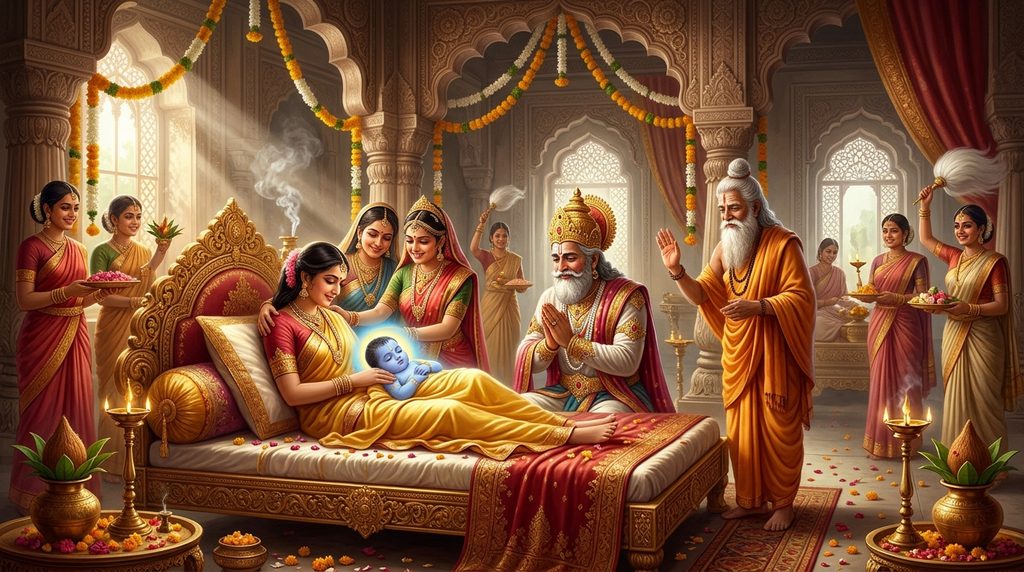
According to the Ramayana, Lord Rama was born in Ayodhya, the capital of the ancient kingdom of Kosala. His father was King Dasharatha, a respected ruler who longed for an heir to continue his royal lineage.
Rama’s mother was Queen Kaushalya. He had three brothers: Bharata, the son of Queen Kaikeyi, and Lakshmana and Shatrughna, the sons of Queen Sumitra.
The four brothers grew up in the royal household, each with his own qualities, yet their relationships remained central to the epic’s emotional depth.
Traditional accounts describe Rama’s birth as a moment of divine blessing.
Devotees celebrate it as Rama Navami, a festival that remembers the birth of Shri Ram and expresses gratitude for his presence in the world.
The family relationships in the Ramayana are especially meaningful because they show that love and duty can sometimes become complicated.
Dasharatha loves Rama deeply, but a promise made to Kaikeyi eventually changes the course of the entire royal family.
Rama’s childhood and upbringing prepare him for the challenges that follow.
He learns discipline, receives instruction from respected sages, and develops the courage and judgment expected of a prince.
The Story of Lord Rama in the Ramayana
The Ramayana, traditionally attributed to the sage Valmiki, is the principal epic associated with Lord Rama.
It tells the story of his birth, marriage, exile, search for Sita, battle against Ravana, and eventual return to Ayodhya.
Although the narrative contains extraordinary events and divine elements, its enduring appeal comes from the human emotions woven throughout it.
Family loyalty, separation, grief, friendship, and hope all play important roles.
Different regional and religious traditions preserve their own versions of Rama’s story.
The Valmiki Ramayana and the Ramcharitmanas, composed by Tulsidas, are among the best-known works through which generations have learned about Shri Ram.
These texts do more than preserve an ancient narrative. They inspire devotional songs, dramatic performances, moral reflection, and countless artistic expressions across South Asia and beyond.
Rama and Sita’s Marriage
One of the most memorable episodes in the story of Lord Rama is his marriage to Sita, the daughter of King Janaka of Mithila.
According to the traditional account, Rama demonstrates his extraordinary strength by lifting and stringing the mighty bow associated with Lord Shiva during the royal ceremony.
Sita and Rama’s marriage becomes an important part of the Ramayana, representing a bond that faces severe tests in the years ahead.
Their relationship is remembered through themes of commitment, devotion, and shared hardship.
Their story is also interpreted in different ways across Hindu traditions, with devotees reflecting on its spiritual symbolism as well as its place in the larger epic.
Why Did Lord Rama Go Into Fourteen Years of Exile?
Rama’s exile is one of the defining moments of the Rama Avatar story in Hindu mythology. Before Rama is crowned king, Queen Kaikeyi invokes two promises that King Dasharatha had previously made to her.
She asks that Bharata receive the throne and that Rama spend fourteen years in the forest.
Although Dasharatha is devastated, Rama accepts the decision rather than allowing his father’s promise to be broken.
His response demonstrates his commitment to duty, even at a tremendous personal cost.
Sita chooses to accompany her husband, and Lakshmana also joins them. Together, they leave the comforts of Ayodhya and begin a life in the forest.
Their departure is heartbreaking for the royal family and the people of Ayodhya.
Yet this difficult period becomes the foundation for many of the epic’s most important lessons about sacrifice, loyalty, and the meaning of righteousness.
Sita’s Abduction by Ravana
During the forest exile, Rama, Sita, and Lakshmana spend time in the region associated with Panchavati.
Their lives take a dramatic turn when Ravana, the ruler of Lanka, abducts Sita and carries her away to his kingdom.
Rama searches desperately for Sita, and the journey brings him into contact with new allies.
His grief becomes a driving force, but the search also reveals his ability to form friendships and work with others toward a shared purpose.
The episode of Sita Haran by Ravana is central to the conflict between Rama and Ravana. It presents the consequences of pride, desire, and the disregard for another person’s freedom and dignity.
The story moves from a personal struggle to a larger confrontation over justice and the restoration of moral order.
Hanuman’s Devotion and the Alliance With Sugriva
During his search for Sita, Rama meets Hanuman, one of the most beloved figures in Hindu tradition.
Hanuman’s intelligence, courage, humility, and extraordinary devotion make him an essential companion in Rama’s mission.
Rama also forms an alliance with Sugriva, the exiled ruler of the vanaras, a group described in the epic through a distinctive blend of humanlike and animal characteristics.
This alliance helps Rama build the support needed to reach Lanka.
Hanuman’s journey to Lanka, his discovery of Sita in Ashoka Vatika, and his return with news of her location are among the most celebrated episodes of the Ramayana.
The relationship between Lord Rama and Hanuman illustrates the meaning of bhakti, or loving devotion to God.
Hanuman’s service is not driven by a desire for personal reward. He acts with courage because his heart is devoted to Rama and the purpose they share.
Rama Setu and the Journey to Lanka
After learning where Sita is being held, Rama and his allies prepare to reach Lanka.
Traditional accounts describe the construction of Rama Setu, also known as Ram Setu, a bridge associated with the journey across the sea.
The bridge holds a special place in religious storytelling and devotional imagination. It represents the collective effort required to overcome an enormous obstacle.
The episode also highlights a recurring theme in Rama’s life: even a powerful leader cannot accomplish everything alone.
Success depends on trust, cooperation, planning, and the contributions of many individuals.
The journey to Lanka prepares the way for the final confrontation with Ravana, where the conflict between dharma and adharma reaches its decisive point.
The Battle Between Rama and Ravana
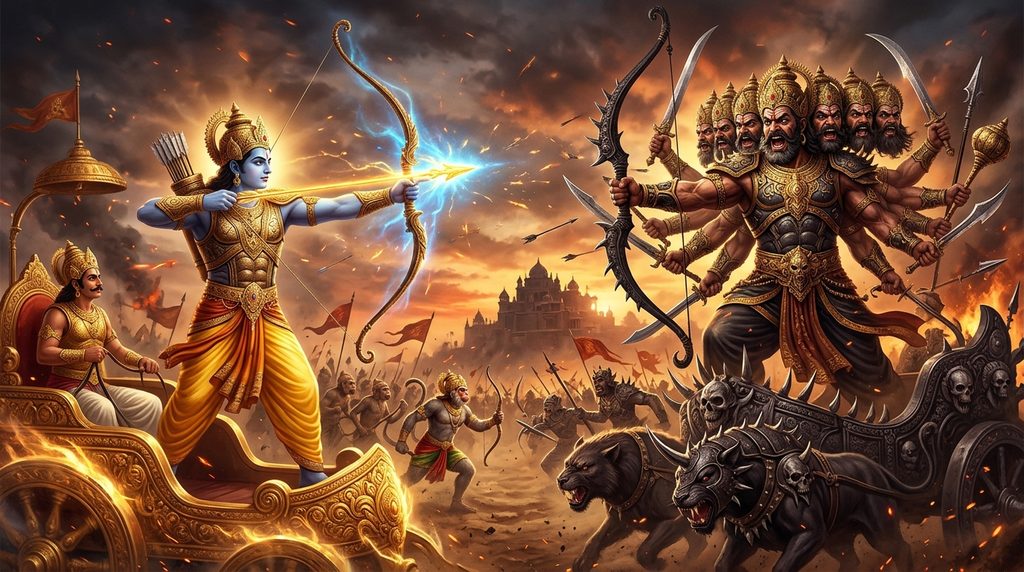
The battle between Rama and Ravana is the dramatic climax of the Ramayana. Ravana is portrayed as a powerful and learned ruler whose arrogance and wrongful actions ultimately bring about his downfall.
The conflict involves many important figures, including Lakshmana, Hanuman, Sugriva, Kumbhakarna, and Meghanada.
Their actions shape the course of the war and reveal the consequences of loyalty, ambition, courage, and pride.
Rama ultimately defeats Ravana, bringing the conflict to an end and making it possible for Sita to return. The victory is commonly understood as a symbol of the triumph of dharma over adharma.
However, the deeper meaning of this episode is not simply that good people always win without difficulty.
The epic shows that the path toward justice can involve fear, loss, uncertainty, and great sacrifice.
The defeat of Ravana remains one of the central stories remembered during Dussehra and Vijayadashami, when communities celebrate the victory of good over evil.
Lord Rama’s Return to Ayodhya
After the events in Lanka and the completion of his exile, Rama returns to Ayodhya with Sita and his companions.
His return marks a joyful moment in the epic, bringing hope to the people who have waited for him.
Hindu tradition connects this homecoming with Diwali, the festival of lights.
In many popular retellings, people illuminate their homes with lamps to welcome Rama, Sita, and Lakshmana after their long journey.
The image of a city filled with light has become one of the most enduring symbols of the festival.
It expresses joy, renewal, and the hope that darkness will give way to understanding and goodness.
Rama’s return also prepares the way for the ideal of Ram Rajya, a model of righteous kingship associated with justice, peace, and public welfare.
Why Is Lord Rama Called Maryada Purushottama?
The title Maryada Purushottama is commonly used for Lord Rama and is often understood as the ideal person who upholds moral boundaries, duties, and righteous conduct.
The expression reflects his reputation for discipline, integrity, and responsibility.
Rama is admired as an ideal son because he honors his father’s promise, even when doing so requires a painful sacrifice.
He is remembered as a loyal brother through the relationships he maintains with Lakshmana, Bharata, and Shatrughna.
He is also portrayed as an ideal king because his role involves more than enjoying royal privileges.
A ruler must protect the people, maintain justice, and place public responsibilities above personal comfort.
These ideals invite reflection rather than simple imitation. Some episodes of the Ramayana involve difficult moral questions, and readers from different traditions interpret them in different ways.
Engaging thoughtfully with those questions can deepen an understanding of the epic rather than diminish its importance.
The lasting significance of Maryada Purushottama Shri Ram lies in the continuing discussion of how a person can balance personal feelings, social responsibilities, compassion, and moral principles.
The Spiritual Significance of Rama Avatar
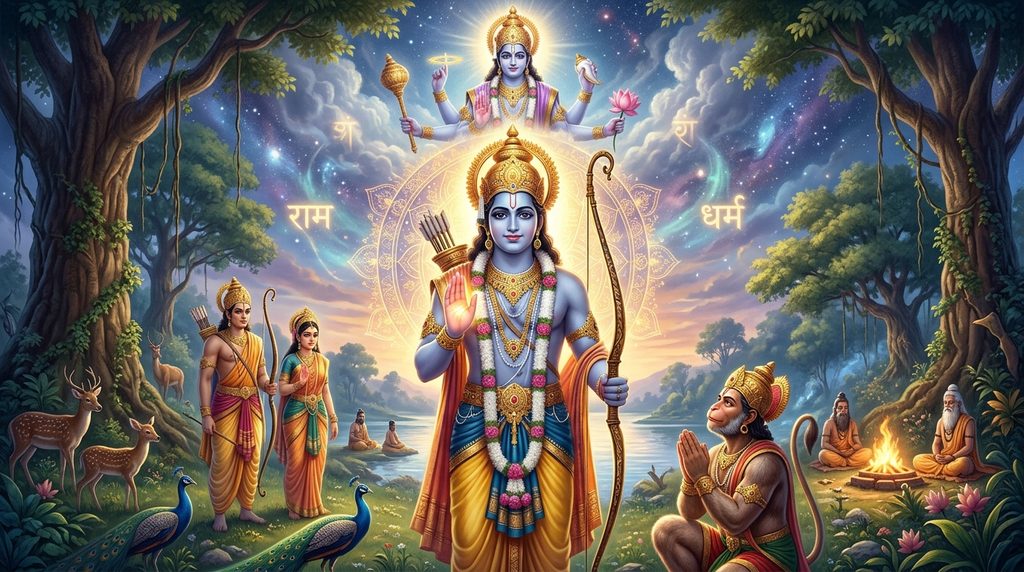
For devotees, the Rama Avatar represents the divine presence working through a life devoted to righteousness. Rama’s story gives spiritual meaning to ordinary responsibilities, from family relationships to leadership and service.
His example encourages people to recognize that faith is not limited to prayer or ritual. It can also appear through honest work, kindness, patience, and the willingness to stand against injustice.
Dharma and Righteousness
Dharma is one of the central ideas associated with Lord Rama. Although the term has several meanings depending on context, it commonly includes duty, moral order, responsibility, and conduct that supports a well-ordered life.
The Ramayana repeatedly explores situations where duty becomes difficult. Rama’s exile, the search for Sita, and the responsibilities of kingship all demonstrate that moral choices can carry real costs.
For readers, these episodes invite an important question: how can a person remain principled when circumstances become uncomfortable? Rama’s story offers one traditional framework for thinking about that challenge.
Rama Bhakti and Devotional Practice
Rama Bhakti refers to devotion to Lord Rama. It can be expressed through chanting his name, reciting sacred texts, singing devotional poetry, visiting temples, and participating in community celebrations.
For many families, devotional practices are woven into daily life. A short prayer in the morning or the recitation of a passage from the Ramayana can become a moment of calm amid an otherwise busy day.
The name of Shri Ram is also widely used in devotional songs and spiritual gatherings. Through these practices, devotees express love, seek guidance, and strengthen their connection with their religious tradition.
Compassion, Courage, and Self-Discipline
Lord Rama’s story brings together several qualities that remain meaningful in everyday life. Courage helps a person face hardship, compassion encourages respect for others, and self-discipline supports responsible choices.
These values are not reserved for kings or epic heroes. They can be practiced through small actions, such as keeping a promise, listening patiently, protecting someone who is vulnerable, or admitting a mistake.
The spiritual lesson of the Rama Avatar is therefore both grand and personal. A story that describes an extraordinary divine incarnation can also encourage ordinary people to live with greater honesty and care.
Lord Rama as an Ideal Son, Brother, Husband, and King
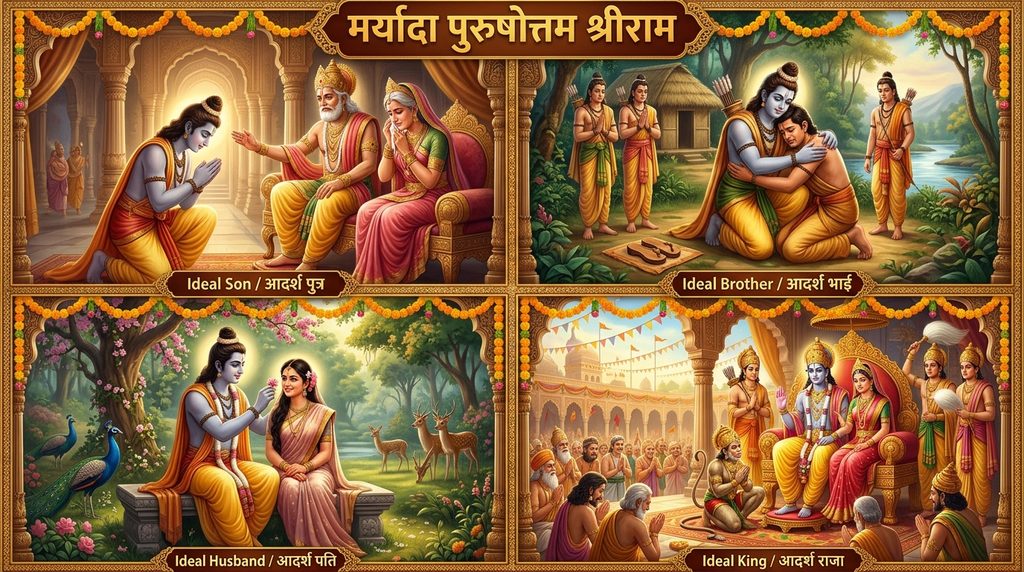
The Ramayana presents Rama through several relationships, each revealing a different aspect of his character. These relationships help explain why his story has remained central to Hindu religious and cultural life.
As a son, Rama accepts the consequences of his father’s promise. As a brother, his relationship with Lakshmana reveals the importance of loyalty, while Bharata’s refusal to enjoy the throne in Rama’s absence demonstrates a different form of brotherly devotion.
As a husband, Rama’s relationship with Sita stands at the heart of the epic’s emotional journey. Their separation and reunion shape many of its most important events.
As a king, Rama is associated with the ideal of placing justice and public welfare at the center of governance. The concept of Ram Rajya continues to be used as an expression of a society guided by fairness, peace, and responsible leadership.
These roles do not make the epic a simple manual for every modern situation. Instead, they offer a rich tradition through which readers can discuss family duties, personal values, leadership, and the consequences of difficult decisions.
Ram Rajya: The Meaning of Righteous Kingship
Ram Rajya is a term associated with the ideal kingdom of Lord Rama. In Hindu thought and cultural memory, it evokes a society in which people can live with dignity, justice, security, and peace.
The ideal is connected with the belief that a ruler should work for the welfare of the community rather than simply protect personal interests. Leadership, in this understanding, involves accountability and service.
Ram Rajya is also a powerful cultural symbol. Over time, the expression has been used in religious discussions, literature, and public life to describe aspirations for fair governance and social well being.
Its meaning is most constructive when connected to the principles of justice, inclusion, and compassion. The image of an ideal kingdom can encourage people to think about the kind of society they want to build and the responsibilities required to achieve it.
Rama Navami, Diwali, and Dussehra: Festivals Celebrating Lord Ram
The story of Lord Rama lives on not only through scripture but also through festivals that bring families and communities together. These celebrations preserve traditions, strengthen devotional connections, and pass cultural knowledge from one generation to another.
Rama Navami
Rama Navami celebrates the birth of Lord Rama and is observed by devotees in India and in Hindu communities around the world.
Celebrations may include prayers, fasting, devotional singing, recitations from the Ramayana, and visits to Hindu temples. Some communities organize processions or special worship ceremonies.
For many families, the festival is also an opportunity to tell children the story of Shri Ram and explain why his values remain important. The celebration becomes a way of connecting a sacred narrative with everyday life.
Diwali and the Return of Shri Ram
Diwali is widely celebrated as the festival of lights, with different communities observing several religious and cultural meanings.
In the Rama tradition, it is especially associated with the return of Rama, Sita, and Lakshmana to Ayodhya after the exile.
Homes and streets are decorated with lamps, families exchange sweets, and people gather to celebrate hope and renewal. The lighted lamps symbolize joy and the welcoming of goodness into one’s home and heart.
The connection between Rama and Diwali is one reason his story remains familiar even to people who may not read the entire Ramayana.
Dussehra and Vijayadashami
Dussehra, also known as Vijayadashami in many regions, is associated with the victory of Rama over Ravana.
Public celebrations may include Ramlila, dramatic performances depicting episodes from the Ramayana, followed by the symbolic burning of effigies of Ravana.
The details of these traditions vary across regions, and Dussehra also carries other religious meanings in Hindu traditions. In the Rama narrative, however, the central message is the victory of righteousness over wrongdoing.
These performances make the epic accessible through theatre, music, costumes, and storytelling.
Children watch the characters come alive, while older generations recognize familiar scenes and pass on the stories they grew up hearing.
Valmiki Ramayana and Ramcharitmanas: Sacred Texts of Rama’s Story
Two particularly influential works associated with Lord Rama are the Valmiki Ramayana and the Ramcharitmanas.
The Valmiki Ramayana is a Sanskrit epic traditionally attributed to the sage Valmiki.
It presents the life and journey of Rama through a detailed narrative of family relationships, exile, the search for Sita, the battle in Lanka, and the return to Ayodhya.
The Ramcharitmanas, composed by the poet-saint Tulsidas in the Awadhi literary tradition, retells Rama’s story in a form that has had enormous influence on devotional practice, poetry, music, and public performance.
These works share many central characters and events, yet they belong to distinct literary and devotional contexts.
Other regional Ramayana traditions also offer their own perspectives, reflecting the diversity of Hindu culture.
Together, these texts demonstrate that the story of Rama is not confined to a single book or performance. It continues to grow through interpretation, devotion, art, and the lived experiences of communities.
Lord Rama’s Teachings and Life Lessons for Modern Times
The lessons associated with Lord Rama can be applied thoughtfully to contemporary life. His story does not promise that good intentions will remove every obstacle, but it offers values that can guide people through uncertainty.
Keep Your Promises
Rama’s response to exile is a powerful reminder that promises matter. In daily life, this principle can mean honoring commitments, communicating honestly, and recognizing when others depend on our word.
At the same time, responsible decision-making requires thoughtfulness. A promise should never be used to justify harm or unfair treatment, and the circumstances surrounding difficult choices deserve careful consideration.
Stand Against Injustice
The conflict with Ravana emphasizes the importance of confronting wrongdoing. In modern life, standing against injustice might involve speaking up when someone is mistreated, supporting a person in need, or refusing to benefit from dishonest behavior.
Courage does not always look dramatic. Sometimes it is simply the decision to do the right thing when staying silent would be easier.
Value Friendship and Cooperation
Rama’s alliance with Sugriva and his relationship with Hanuman show how trust and cooperation can help overcome major challenges.
This lesson applies to families, workplaces, and communities. People often achieve more when they respect one another’s strengths and work toward a shared goal rather than attempting to do everything alone.
Practice Humility Alongside Strength
The story of Rama celebrates courage, but it also highlights the importance of discipline and responsibility. Strength becomes more valuable when guided by humility and concern for others.
A capable person does not need to humiliate others to prove their worth. True leadership involves listening, learning, and using one’s abilities for constructive purposes.
Choose Compassion in Difficult Moments
The Ramayana contains moments of grief, conflict, and difficult judgment. These episodes encourage readers to consider the emotional consequences of decisions and the responsibilities that accompany power.
Compassion does not mean ignoring wrongdoing. It means recognizing the humanity of others while working toward justice and better outcomes.
The Cultural Influence of Lord Rama Across India and Beyond
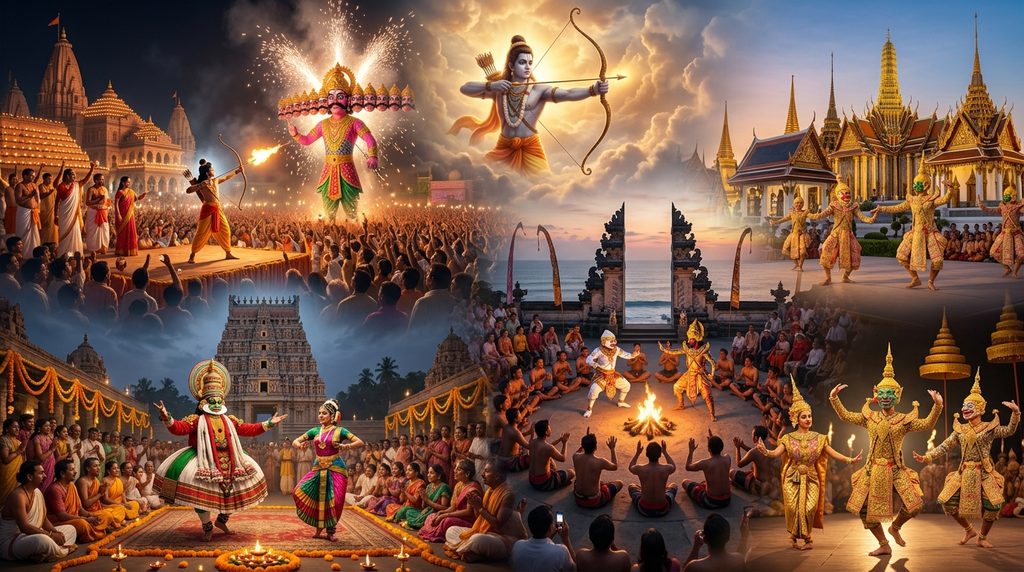
Lord Rama’s influence extends far beyond the pages of the Ramayana. His story appears in devotional songs, classical and folk theatre, sculpture, painting, television adaptations, dance, and community storytelling.
In many regions, Ramlila performances bring the epic into public spaces. Performers portray Rama, Sita, Lakshmana, Hanuman, and Ravana, allowing audiences to experience familiar episodes through dramatic action and music.
The story has also traveled across South and Southeast Asia, where different communities have developed their own literary and artistic interpretations.
These versions sometimes differ in their details, showing how the Rama tradition has been adapted to local languages and cultural settings.
Hindu temples dedicated to Lord Rama provide spaces for worship, festivals, and community gatherings.
For devotees, these places are not merely architectural landmarks; they are settings for prayer, remembrance, and a sense of belonging.
Through these traditions, the Rama Avatar remains a living part of religious and cultural life.
Its continued presence shows how an ancient epic can retain meaning while being interpreted by new generations.
Frequently Asked Questions About Rama Avatar
Who is Lord Rama?
Lord Rama is a major deity in Hinduism and is traditionally regarded as the seventh avatar of Lord Vishnu.
He is the central figure of the Ramayana and is associated with dharma, courage, devotion, and righteous conduct.
Why is Rama the seventh avatar of Vishnu?
In the commonly taught Dashavatara sequence, Rama follows Parashurama and precedes Krishna.
His incarnation is associated with restoring dharma and defeating Ravana, whose actions represent the misuse of power and the violation of moral order.
Who were Lord Rama’s parents?
Lord Rama’s father was King Dasharatha, and his mother was Queen Kaushalya. His three brothers were Bharata, Lakshmana, and Shatrughna.
Why did Lord Rama spend fourteen years in exile?
According to the Ramayana, Queen Kaikeyi invoked two promises made to her by King Dasharatha.
She requested that Bharata become king and that Rama spend fourteen years in the forest. Rama accepted the exile to honor his father’s commitment.
What is the relationship between Lord Rama and Hanuman?
Hanuman is one of Rama’s most devoted companions. He helps search for Sita, travels to Lanka, and supports Rama during the conflict with Ravana.
Their relationship is widely celebrated as an example of bhakti, humility, courage, and selfless service.
What is the spiritual meaning of Rama Avatar?
The Rama Avatar represents the divine restoration of dharma. For devotees, Rama’s life offers guidance on responsibility, integrity, courage, devotion, and the importance of using power in the service of righteousness.
How are Lord Rama and Diwali connected?
In the Rama tradition, Diwali is associated with the return of Rama, Sita, and Lakshmana to Ayodhya after fourteen years of exile.
Lighting lamps expresses joy, welcome, and the symbolic triumph of light over darkness.
What does Maryada Purushottama mean?
Maryada Purushottama is an honorific associated with Lord Rama. It is commonly understood as referring to the ideal person who upholds righteous conduct, moral boundaries, and responsibility.
read more https://gavorexium.com/swaminarayan-akshardham/
Conclusion: Why the Rama Avatar Remains Meaningful Today
The story of Lord Rama is much more than a tale of a prince who defeats a powerful king. It is a journey through duty, love, sacrifice, friendship, courage, and the challenges of making difficult decisions.
As the seventh avatar of Vishnu, Rama represents the restoration of dharma and the belief that righteousness deserves to be protected.
Through his relationships with Sita, Lakshmana, Bharata, and Hanuman, his story explores the many ways loyalty and responsibility shape a person’s life.
His influence continues through the Ramayana, Ramcharitmanas, Rama Navami, Diwali, Dussehra, temple worship, and countless cultural traditions. Each generation finds new questions to consider and familiar values to carry forward.
Perhaps the most lasting lesson of the Rama Avatar is that goodness is not only something to celebrate in a story.
It is something to practice, through honest words, thoughtful decisions, compassion toward others, and the courage to act with integrity when life becomes difficult.